
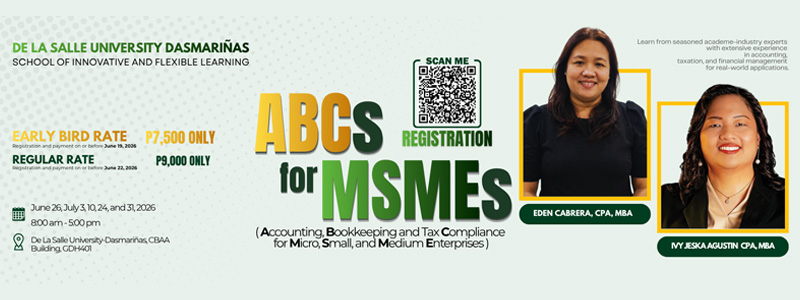
This micro‑credential course provides non‑accountants with a comprehensive and structured introduction to accounting, bookkeeping, and basic taxation for service and merchandising businesses. Participants will develop a solid understanding of accounting principles, concepts, and processes, alongside practical skills in maintaining books of accounts and preparing financial reports.
The Accounting, Bookkeeping, and Tax Compliance for MSMEs (ABCs for MSMEs) is a micro‑credential program designed to equip non‑accountants, entrepreneurs, and finance support staff with essential and practical competencies in accounting, bookkeeping, and basic taxation. Grounded in real-world MSME scenarios, the program blends foundational accounting concepts with hands-on exercises, guided problem-solving, and simplified tools appropriate for small and growing enterprises.
Throughout this 40-hour intensive training, participants will learn the complete accounting cycle for both service and merchandising businesses—from transaction analysis and recording to financial statement preparation and closing processes. The program also strengthens financial management capabilities through modules on cash controls, bank reconciliation, and financial statement analysis.
A key feature of the program is the integration of income and business tax concepts and compliance, enabling participants to understand tax obligations, prepare basic tax computations, and complete essential filing requirements.
Designed using an innovative and learner-centered approach, this training ensures that participants gain practical, immediately applicable skills that enhance financial management, regulatory compliance, and informed business decision-making.
This micro‑credential course provides non‑accountants with a comprehensive and structured introduction to accounting, bookkeeping, and basic taxation for service and merchandising businesses. Participants will develop a solid understanding of accounting principles, concepts, and processes, alongside practical skills in maintaining books of accounts and preparing financial reports.
The course systematically guides learners through the accounting cycle, including transaction analysis, journalizing, ledger posting, trial balance preparation, adjusting and closing entries, worksheet preparation, and financial statement construction. For merchandising operations, emphasis is placed on special journals, inventory systems, VAT applications, and the voucher system as part of internal controls.
In addition, the program introduces income and business taxation, covering taxpayer identification, computation of taxable income, allowable deductions, and basic compliance procedures such as preparation of tax forms and understanding filing requirements.
The course concludes with modules on cash control systems and financial statement analysis using key analytical tools and ratios.
Upon completion, participants earn a micro‑credential certificate signifying their enhanced ability to manage accounting records, comply with tax regulations, and use financial information for effective business decision-making.
By the end of the program, participants will be able to:
The School of Innovative and Flexible Learning and the College of Business Administration and Accountancy – Accountancy Department.
Participants will engage in:
By the end of the program, participants will complete:
Participants who successfully complete the required outputs and demonstrate practical competence in bookkeeping, financial statement analysis, cash controls, and tax compliance will receive a micro-credential certificate recognizing their enhanced business finance competencies.
Take the next step toward smarter financial management and business growth through the ABCs for MSMEs Micro-Credential Program.